

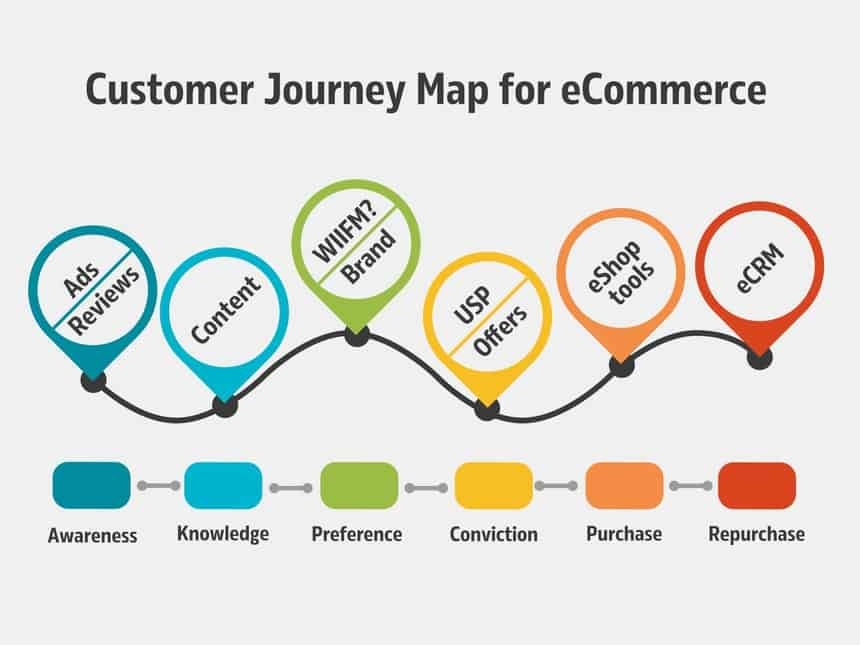
The stages of a customer’s experience with an online business, beginning with the moment they are first made aware of the company’s products and ending with the moment they have successfully completed a purchase, are collectively referred to as the “ecommerce customer journey.”
Your potential customers are more likely to form a favourable impression of your company if they have an easy time navigating your website and using its features. Take, for instance:
Why is it important to understand the ecommerce customer journey?
The aggregate of your customers’ experiences while using your website serves as the basis for their perceptions of your company and their decisions regarding whether or not they will make purchases from you. It is helpful to look at a customer’s experience as a whole and to understand what they may be looking for and needing at different times if one imagines these interactions as a “journey” made up of separate stages. This is a convenient way to look at the experience of a customer.
There are five stages of the customer journey in e-commerce.
The idea of a “customer journey” is widely used in marketing, but it’s possible that your customers don’t realise, or at the very least aren’t thinking about, how their actions on your website can be interpreted as “stages” in a journey at all. They are actually going through each stage rather than contemplating it beforehand.
You might be familiar with the traditional terms that are used to describe the stages of the ecommerce customer journey, which typically include the following:
- Awareness
- Consideration
- Acquisition
- Retention
- Advocacy
However, in the interest of putting the customer first and adhering to the principles of customer centricity, we have decided to rename the various stages of the customer journey.
In addition, the following is how each stage relates to your company:
Phase 1: the stage of discovery
Your product is brought to the customer’s attention
At this point in the process, you are able to learn where customers use to be coming from, what transported them to your website, which pages they are landing on and navigating to, and the path that took them from one page to another. This presents an opportunity to learn about the requirements of new customers, specifically what it is that they are searching for on your website.
Interest
After finding something on your website that piques their interest, the customer begins to explore the rest of your offerings: “They might have the perfect sofa for our living room—I’m going to take a look.”
Intent
The potential buyer may add items to a wishlist or trolley, but at this point, they are only thinking about making the acquisition. Businesses that operate online may be able to determine which page features are working to their advantage and what motivates customers to add products to their wishlists and shopping carts by analysing visitor data. It is also possible for a new marketing channel to enter the journey at this stage. That channel is the email list.
Purchase
This stage is also known as the “conversion stage,” and it refers to the moment when the customer actually makes a purchase of your product (“Yup, this is the one! It couldn’t be better!)
You are now in a position to begin constructing a long-term relationship with your customers and to discover opportunities to provide improved service to them in the foreseeable future. This point in the process is also an excellent time to conduct a post-purchase survey and collect some immediate feedback from customers who have recently completed a purchase from your company on what worked well for them and what could be improved.
Engagement
The customer comes back for more, which may include making another purchase, interacting with the brand on social media, subscribing to the company newsletter, reading articles, and signing up for customer-exclusive bonuses and upsells.
