

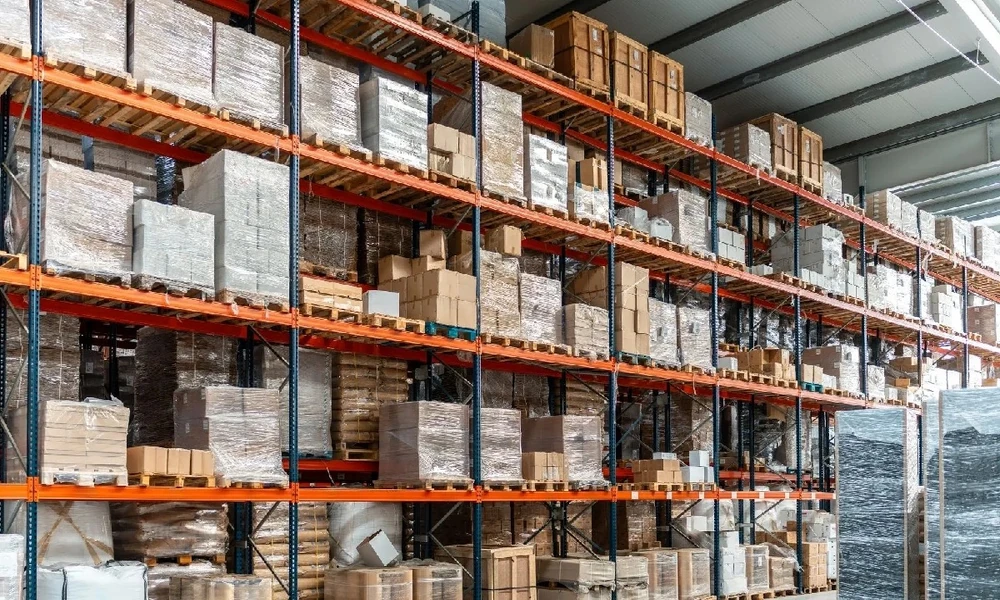
The usual way to size a racking project is to count pallets and divide by the positions each bay provides. That calculation treats every pallet as equal, when the pallets in a warehouse behave very differently: some leave within days, others sit for months, and some arrive forty at a time. The more useful question is which pallet racking system suits your stock turnover, because the rate and pattern of movement decide how much access is worth paying for and how much density the operation can tolerate.
What Stock Turnover Really Describes
Turnover is the number of times the average inventory of a product is sold or consumed in a period. A line that turns twenty times a year spends less than three weeks in the building; one that turns twice may occupy the same position for six months. Looked at across a whole range, turnover separates the pallets that generate most of the truck movements from those that mostly generate rent.
Sorting the Range Into Fast, Medium and Slow
A simple analysis ranks every product line by the number of pallet movements over a year. In most warehouses a small share of lines accounts for the bulk of activity, a middle group moves steadily and a long tail hardly moves at all. Alongside that ranking, record how many pallets of each line are held at peak. The two figures together, movement and depth of stock, point towards a storage method far more reliably than a total pallet count ever can.
High Turnover and a Wide Range
Where many different lines move quickly, every pallet needs to be reachable without delay. Selective racking provides this, since each position faces an aisle and nothing has to be shuffled to reach the load required. Its relatively low density is the price of speed and accuracy. Placing the fastest lines in the bays nearest despatch, at levels that can be served without full mast extension, shortens travel and lift times for the movements that occur most often.
High Turnover of a Few Bulk Lines
A different pattern arises when a handful of products move in large volumes, as with beverages, packaging or raw materials delivered by the container. Here dozens of identical pallets arrive and leave together, and dedicating an aisle-facing position to each is wasteful. Drive-in lanes or double-deep bays hold these blocks compactly. Because each lane fills and empties as a batch, the restriction on reaching individual pallets rarely causes difficulty, provided each lane is kept to a single product and a single batch.
Slow Movers and the Long Tail
Slow lines present the opposite problem: many different products, few pallets of each and infrequent access. They need selectivity but do not justify generous aisles. Very narrow aisle racking suits them well, cutting aisle width by up to half and using height to recover capacity. Operators asking which pallet racking system suits your stock turnover often find that the long tail is where space is being lost, with rarely touched pallets occupying prime positions that faster lines should have been given long ago.
Rotation Rules: First In or Last In
Turnover is not only a matter of speed. Goods with expiry dates, batch traceability or a risk of obsolescence must leave in the order they arrived. Selective and narrow aisle racks allow any rotation rule. A drive-in lane loaded from one side releases the newest pallet first, as does a double-deep bay, so they suit products without date sensitivity or lanes that empty completely between batches. Drive-through lanes, loaded and unloaded from opposite ends, restore first-in, first-out at some cost in floor area.
Seasonal Peaks and Changing Profiles
Turnover figures are averages, and averages conceal peaks. A line that is slow for nine months may dominate the warehouse before a festive season. Racking chosen only for the average will be short of positions when stock builds. Adjustable beam levels, and a share of flexible selective bays, allow the layout to absorb such swings.
Handling Equipment and Labour
Each system implies a certain truck and a certain work rate. Selective racking works with common reach trucks and delivers quick cycles. Narrow aisle layouts require specialised trucks that are productive within the aisles but need support at the ends. Drive-in lanes slow every movement because the driver must enter the structure carefully. If labour is the scarce resource, a design that saves floor area at the cost of slower handling may not be the bargain it first appears.
Mixing Systems Within One Warehouse
Because most businesses hold stock in more than one of these categories, a combined layout is common. Bulk lines go into lane storage, the active range into selective bays and the slow tail into narrow aisles or upper levels. Zoning in this way lets each group sit in the structure that matches its movement. The boundaries should be reviewed as the figures change, and adjustable racking makes it practical to convert bays from one duty to another over time.
Turning the Analysis Into a Decision
Begin with twelve months of movement data and the peak holding of each line. Group the range by speed and depth of stock, note which products require strict rotation and list the trucks and building limits that cannot change. With that information on one page, the answer to which pallet racking system suits your stock turnover is usually apparent, and it is often more than one system. A supplier given this brief can design to the way the stock behaves, not merely to the number of pallets on hand.
