

By Daniel Leinhardt
Financial technology is changing at a pace that many traditional institutions struggle to match.
Over the past few years, we have watched banks, payment companies, blockchain firms, and fintech startups increasingly work together rather than compete directly. What once seemed like separate industries are gradually becoming interconnected.
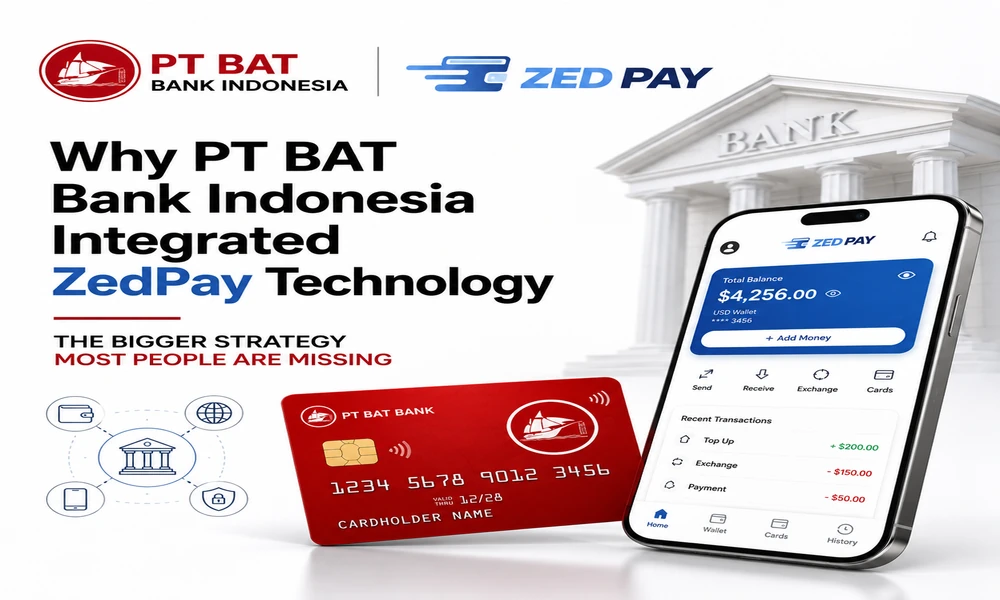
That is why recent confirmation that PT BAT Bank Indonesia is integrating ZedPay technology attracted my attention.
Almost immediately, one question began appearing repeatedly.
If PT BAT is a bank, why integrate another company’s technology? Why not simply build everything internally?
At first glance, that seems like a reasonable question.
But after researching digital banking, payment infrastructure, blockchain technology, and financial modernization, I believe that question overlooks a much bigger transformation taking place across global finance.
This is not simply a story about one company using another company’s software.
It is a story about how banking itself is evolving.
Banking Is No Longer Built the Way It Was Twenty Years Ago
For decades, banks developed most of their critical systems internally.
Payment processing.
Customer databases.
Card management.
Risk systems.
Settlement infrastructure.
Banks wanted complete ownership over their technology because technology changed relatively slowly.
Today, that environment no longer exists.
Digital finance evolves almost continuously.
Consumer expectations change rapidly.
Payment technologies improve every year.
Cybersecurity standards evolve.
Artificial intelligence is reshaping customer service.
Digital wallets continue expanding.
Cross-border payment systems are becoming faster.
Blockchain infrastructure continues to mature.
Trying to build every new capability internally can become both expensive and time-consuming.
That reality has encouraged many financial institutions around the world to adopt a different strategy.
Rather than building everything themselves, many now partner with specialized technology providers.
Why Fintech Partnerships Make Strategic Sense
Building financial infrastructure is far more complicated than designing a mobile application.
Behind every payment platform are multiple layers of technology that most users never see.
These include:
– Transaction routing
– Fraud detection
– Identity verification
– Compliance monitoring
– Anti-money laundering controls
– Liquidity management
– Multi-currency settlement
– Security architecture
– Regulatory reporting
– High-availability infrastructure
Each of these systems requires years of engineering, extensive testing, regulatory oversight, and ongoing maintenance.
Developing all of that internally may not always be the most efficient approach.
If an experienced technology provider has already invested years into developing secure infrastructure, integrating that technology can significantly reduce development time while allowing the institution to focus on its core banking operations.
This approach has become increasingly common throughout financial services.
Understanding What ZedPay Brings
Based on publicly available information, ZedPay positions itself as a financial technology platform offering services that include digital wallets, payment infrastructure, multi-currency capabilities, and technology designed to support modern digital transactions.
Those capabilities are increasingly valuable as customer expectations continue to evolve.
Today’s users expect financial services to be:
– Available instantly
– Accessible from mobile devices
– Easy to use
– Secure
– Compatible with multiple payment methods
– Capable of supporting international transactions
Meeting those expectations requires sophisticated technology.
Rather than viewing fintech providers as competitors, many banks increasingly see them as strategic partners capable of accelerating digital transformation.
Digital Transformation Is About Speed
One of the most important lessons modern businesses have learned is that speed matters.
Developing new financial infrastructure from the ground up can take years.
During that time, technology continues advancing.
Customer expectations continue changing.
Competitors continue innovating.
By the time a new internal platform is completed, the market may already demand additional capabilities.
Strategic partnerships help institutions shorten that timeline.
Instead of beginning from zero, they can build upon technology that already exists while adapting it to their own regulatory and operational requirements.
That allows modernization to happen more quickly.
Lessons from Other Technology Companies
This strategy is not unique to banking.
Many of the world’s largest technology companies rely on partnerships.
A smartphone manufacturer may design its products while sourcing processors, camera sensors, displays, or connectivity technologies from specialized companies.
Automobile manufacturers purchase components from suppliers across multiple industries.
Cloud computing providers integrate third-party software.
Large businesses understand an important principle.
Competitive advantage does not always come from building every component yourself.
Sometimes it comes from assembling the strongest ecosystem.
Financial institutions increasingly appear to be adopting that same philosophy.
Blockchain Is Expanding the Conversation
Another reason these partnerships matter is that financial infrastructure itself is becoming more digital.
Blockchain technology has expanded discussions around:
– Tokenised assets
– Digital ownership
– Cross-border payments
– Smart contracts
– Programmable finance
– Real-world asset tokenisation
Whether these technologies achieve widespread adoption remains to be seen.
However, financial institutions are clearly paying attention.
Rather than ignoring innovation, many appear to be exploring how traditional banking and emerging financial technologies can coexist.
That may ultimately become one of the defining characteristics of the next generation of banking.
A New Generation of Customers
Customer behavior is also changing.
Younger generations often expect financial services to function more like modern technology platforms than traditional banks.
They value:
– Instant transfers
– Mobile-first experiences
– Digital wallets
– Integrated financial applications
– Faster international payments
– Simplified user interfaces
Banks understand that remaining relevant requires adapting to those expectations.
Technology partnerships can help accelerate that transition.
The Bigger Picture
Viewed from a broader perspective, PT BAT Bank Indonesia’s integration of ZedPay technology is not simply a software decision.
It reflects a wider shift occurring throughout financial services.
Increasingly, banks are becoming part of interconnected technology ecosystems rather than isolated institutions operating entirely on proprietary infrastructure.
This trend has implications far beyond one partnership.
It illustrates how finance is gradually becoming more collaborative.
Banks.
Fintech companies.
Payment providers.
Blockchain infrastructure.
Artificial intelligence.
Digital identity systems.
All are beginning to interact more closely than ever before.
Execution Will Determine Success
Of course, partnerships alone do not guarantee success.
Announcements generate attention.
Execution creates value.
The important questions now become:
Can these technologies improve customer experience?
Can they strengthen security?
Can they increase operational efficiency?
Can they remain compliant with evolving regulations?
Can they support long-term innovation?
Those questions matter far more than headlines.
Final Thoughts
I do not view PT BAT Bank Indonesia’s integration of ZedPay technology as a sign of weakness.
If anything, it may reflect a recognition that the future of banking is becoming increasingly collaborative.
No institution can realistically innovate in every area at the same pace.
Strategic partnerships allow organizations to focus on their strengths while benefiting from specialized expertise developed elsewhere.
As blockchain, tokenisation, fintech, artificial intelligence, and digital payments continue converging, partnerships like this may become less unusual and more representative of where global finance is heading.
The future of banking may not belong solely to banks or fintech companies.
It may belong to ecosystems where both work together.
Only time will reveal how successful these collaborations become, but one thing is already clear.
The financial industry is entering a new chapter, and technology partnerships are likely to play an increasingly important role in shaping it.
